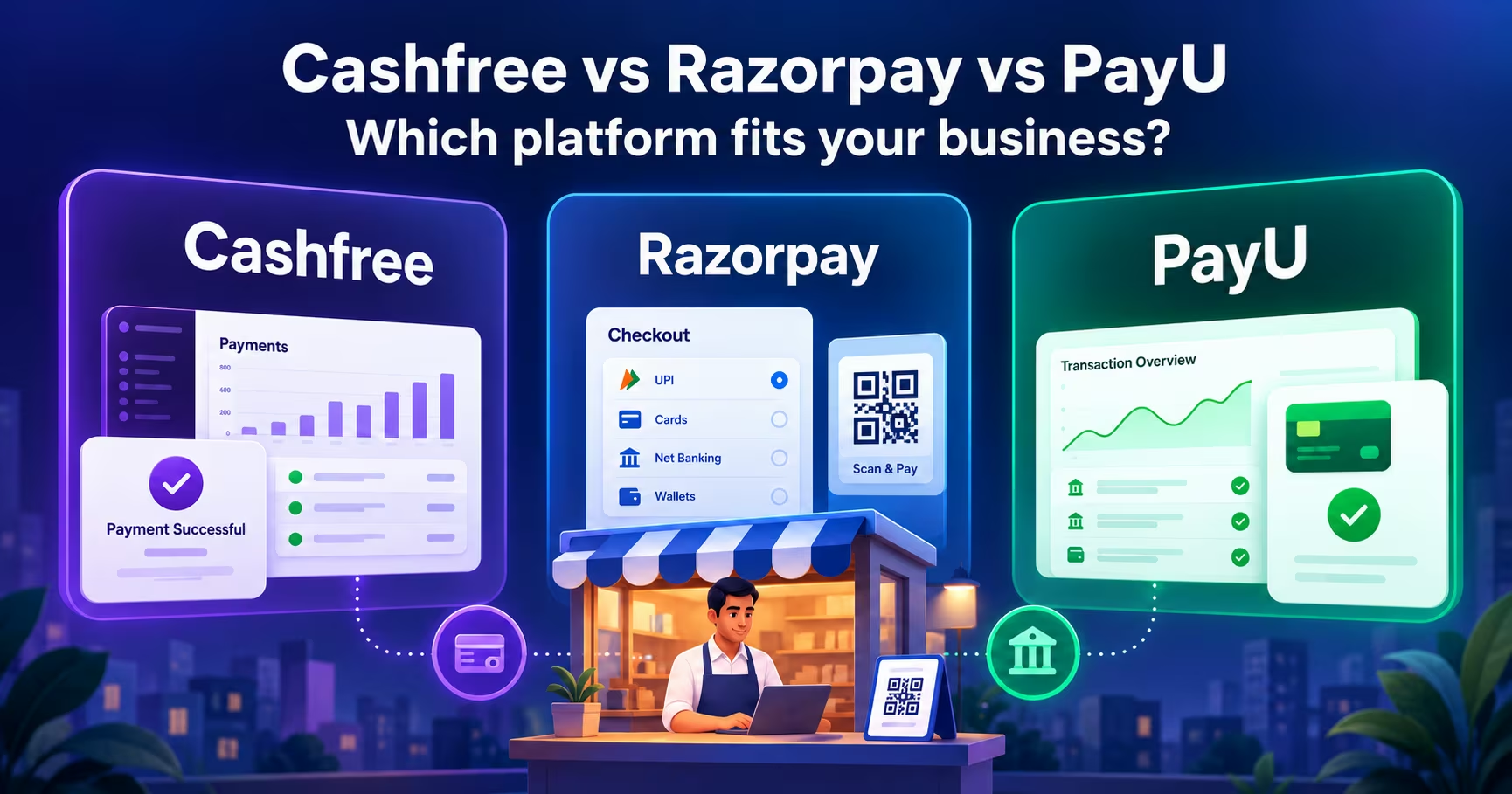
Choosing the wrong international payment gateway as an Indian business can cost 5% to 8% of every invoice, delay your FIRC documentation for weeks, and leave you non-compliant with RBI's PA-CB framework. In 2026, the landscape has been reshaped by a wave of RBI PA-CB licences, the arrival of Apple Pay on Indian payment gateways, and the confirmation that several legacy players no longer hold cross-border authorisation at all.
This guide reviews every major international payment gateway available to Indian businesses in 2026. Each payment gateway is evaluated on real cost, RBI compliance status, transaction success rate, settlement speed, FIRC automation, Apple Pay and Google Pay support, and platform integrations.
Whether you run a SaaS business billing US clients, a D2C brand selling globally on Shopify, or a freelance practice invoicing agencies in the UK, the right international payment gateway depends on your billing model. The wrong one costs you quietly, every month.
Key Takeaways
- The RBI's PA-CB (Payment Aggregator - Cross Border) framework, introduced in 2023, has fundamentally changed which payment gateways can legally operate for cross-border payments. As of 2026, only approximately 19-25 entities hold full PA-CB licences.
- Razorpay is the first Indian payment aggregator to support Apple Pay for international customers, a feature that drives a 58% lift in conversion rates based on Razorpay's own launch data.
- Razorpay achieves a 95%+ cross-border transaction success rate via smart routing across multiple acquiring banks.
- Stripe India has been invite-only since May 2024, surrendered its PA-CB licence in July 2024, and has no confirmed relaunch date. Its all-in cost of approximately 6.3% is also among the highest available.
- CCAvenue does not hold a PA-CB licence as of mid-2026, meaning its cross-border facilitation operates outside the current regulatory framework.
- Auto-generation of eFIRC (Electronic Foreign Inward Remittance Certificate) varies significantly by payment gateway. Without it, you face weeks of manual bank paperwork for every GST refund claim.
- India's cross-border B2C e-commerce market is growing at a 21.61% CAGR and is projected to reach USD 36 billion by 2031. The international payment gateway you choose now will shape how much of that growth actually reaches your bank account.
- Total cost of ownership matters more than headline fee. A payment gateway advertising 2% can cost 5% once FX markup, settlement fees, and FIRC charges are added.
What to Look for in an International Payment Gateway
RBI PA-CB licence. Post-October 2023, any entity facilitating cross-border aggregated payments in India must hold a PA-CB licence. Payment gateways without it operate under legacy OPGSP arrangements or bank partnerships, with lower transaction limits and less regulatory certainty.
Transaction success rate. Cross-border card payments fail more often than domestic ones due to issuer-side restrictions. A payment gateway with smart routing across multiple acquiring banks meaningfully reduces failed payments and lost revenue.
True total cost. Add the transaction fee, FX markup above mid-market rate, settlement fee, and any FIRC or documentation charge. A payment gateway with a 2% headline fee and a 3% FX markup costs more than one charging 3% at mid-market.
Auto-FIRC / auto-eFIRC. FIRC is mandatory for every inward remittance on export of services, and is required for GST refund claims under zero-rated export rules. Payment gateways that auto-generate this per transaction save significant compliance time.
Payment methods accepted. Apple Pay and Google Pay are now standard for international buyers, particularly in the US, UK, and Europe. An international payment gateway without them loses a measurable share of cross-border checkouts.
Platform integrations. Native plugins for Shopify and WooCommerce eliminate custom development. Verify integration depth before committing, especially for headless or Webflow setups.
All International Payment Gateways at a Glance
| Payment Gateway | PA-CB Licence | Transaction Fee | Apple Pay | Success Rate | Auto-eFIRC | Shopify | Rating |
|---|
| Razorpay International | Yes - full (Dec 2025) | 3% + GST (cards) | Yes - first Indian PA | 95%+ | Yes | Yes (native) | 4.8/5 |
| PayU International | Yes - full (Nov 2025) | Custom (not published) | Not confirmed | 87%+ | Not confirmed | Not confirmed | 4.0/5 |
| CCAvenue International | No PA-CB licence | Up to 4.99% | Not confirmed | 85%+ | Not confirmed | Via plugins | 3.4/5 |
| Stripe India | No (surrendered Jul 2024) | ~6.3% all-in | No | 90%+ | Manual only | Yes | 3.0/5 |
| PayPal | In-principle only (May 2025) | ~8.25% all-in | No | NA | Weekly batch | Limited | 2.8/5 |
Detailed International Payment Gateway Reviews
1. Razorpay International Payment Gateway - Best Overall for Indian Businesses
Rating: 4.8/5
Razorpay International is the most complete cross-border payment gateway available to Indian businesses in 2026. It holds a full RBI PA-CB licence, supports Apple Pay and Google Pay for international customers, integrates natively with Shopify and WooCommerce, and delivers the highest cross-border success rate among Indian payment gateways.
Key specs:
- Supported cards: Visa, Mastercard, Amex, Apple Pay, Google Pay
- Currencies: 135 currencies from 180+ countries
- Success rate: 95%+ on cross-border transactions (smart routing across multiple acquiring banks)
- Transaction fee: 3% plus 18% GST on cards
- Settlement: T+2
- PA-CB licence: Full (inward and outward), granted December 2, 2025
Apple Pay and conversion performance
In September 2025, Razorpay became the first Indian payment aggregator to launch Apple Pay. Early pilot data showed a 58% lift in conversion rates, 45% faster checkout, and a 12% increase in average order value.
Brands including Mokobara, Akasa Air, and Sabyasachi were among the early adopters, with the 5,000-payment pilot recording a 95% success rate.
Smart routing and success rates
Razorpay routes international transactions across multiple acquiring banks in real time. This reduces the failure rate on cross-border card payments, which typically run 5% to 15% higher than domestic transactions. The result is up to 10% more successful payments compared to single-acquirer routing.
Regulatory standing
Razorpay holds all three RBI payment licences simultaneously: PA-Online, PA-Physical, and PA-CB. It is the only Indian fintech with this combination. The PA-CB licence covers both inward and outward cross-border flows.
Pros:
- Only Indian payment gateway with Apple Pay and Google Pay for international customers
- 95%+ cross-border success rate via smart routing across multiple acquirers
- Full RBI PA-CB licence covering both inward and outward payments
- 135 currencies, 180+ countries
- Auto-eFIRC per transaction
- Native Shopify and WooCommerce integrations
- No setup fee or annual maintenance charge
Cons:
- Card rate at 3% is not the lowest published rate in the market
- Webflow requires Payment Links workaround rather than a native plugin
- Google Pay and Apple Pay availability dependent on customer device and region
Did You Know? Razorpay's cross-border transaction volume grew 40% year-on-year following its PA-CB licence announcement. It is one of only a handful of Indian payment gateways to achieve PA-CB coverage for both receiving and sending cross-border payments.
2. PayU International - Best for Enterprise and Existing PayU Merchants
Rating: 4.0/5
PayU is one of India's largest and longest-running payment gateways, handling over 40% of India's domestic online payment volume. In November 2025, it received integrated RBI authorisation simultaneously as PA-Online, PA-Physical, and PA-Cross Border, making it one of the few payment gateways with full regulatory coverage across all three categories.
Key specs:
- Supported cards: Major international card networks
- Multi-Currency Pricing: Customers pay in their home currency
- Transaction fee: Custom (not publicly disclosed)
- Settlement: T+2 to T+3
- PA-CB licence: Full (inward and outward), granted November 2025
What works well
PayU's main strength is infrastructure at scale. Its cross-border offering plugs into the same API and dashboard that existing merchants already use for domestic payments, making expansion to international acceptance straightforward for established businesses.
It also supports Dynamic Currency Conversion, allowing international customers to pay in their home currency at the checkout stage.
What to watch
PayU does not publish cross-border pricing. Rates are negotiated individually after document verification, which makes pre-signup cost comparison difficult.
Settlement at T+2 to T+3 is also slower than Razorpay's T+2 standard. Apple Pay support has not been confirmed for the international payment gateway at the time of writing.
Pros:
- Full RBI PA-CB licence covering both inward and outward cross-border payments
- One of the largest domestic payment infrastructures in India
- Single platform for domestic, international, and offline payments
- Handles cross-border at enterprise scale
- Dynamic Currency Conversion available for international buyers
Cons:
- Pricing not publicly disclosed, requires direct negotiation before you can compare costs
- T+2 to T+3 settlement is slower than leading payment gateways
- Apple Pay support not confirmed
- Less suited to small businesses or first-time international sellers
- No publicly published cross-border success rate data
Did You Know? India's cross-border B2C e-commerce market was valued at USD 10.94 billion in 2025 and is projected to reach USD 36.09 billion by 2031, a 21.61% CAGR. Over 200,000 Indian sellers were active on Amazon Global Selling alone by late 2025, with Amazon pledging to enable USD 80 billion in cumulative Indian e-commerce exports by 2030.
3. CCAvenue International - Most Established Legacy Payment Gateway
Rating: 3.4/5
CCAvenue is one of India's oldest payment gateways, with broad coverage across 200+ countries and support for international cards from Visa, Mastercard, Amex, JCB, and UnionPay. For businesses with a long-standing CCAvenue relationship and no immediate compliance pressure, it remains functional for basic international card acceptance.
Key specs:
- Currencies: 27 (via Dynamic Currency Conversion)
- Countries: 200+ for card acceptance
- Transaction fee: Up to 4.99% for international cards
- FX: XE rates (not mid-market)
- PA-CB licence: No
The regulatory gap
CCAvenue's parent entity, Infibeam Avenues, does not hold an RBI PA-CB licence as of mid-2026. It holds PA-O (online) and PA-P (physical) authorisations, but not PA-CB. This means cross-border payment facilitation through CCAvenue currently operates under legacy OPGSP-era arrangements, outside the new regulatory framework introduced in 2023.
Cost structure
The pricing is the highest among PA-licensed-or-not payment gateways in this comparison: up to 4.99% on international cards, plus Dynamic Currency Conversion using XE rates rather than mid-market rates, which adds a further hidden FX spread.
Pros:
- Long-established with 200+ payment methods across India
- Supports 27-currency Dynamic Currency Conversion
- 200 countries for card acceptance
- 18-language checkout pages for international buyers
- PCI DSS Level 1 certified
- Smart retry features for failed domestic transactions
Cons:
- No PA-CB licence as of mid-2026 - operates outside the current regulatory framework
- Up to 4.99% international card fee is the highest in this comparison
- DCC uses XE rates, not mid-market, adding a hidden FX cost
- FIRC auto-generation status not confirmed
- Apple Pay not confirmed
- No published cross-border success rate data
4. Stripe India - Strong Product, Very Limited Access
Rating: 3.0/5
Stripe has one of the best developer APIs in the payment gateway category globally, and its international card processing capabilities are genuine. For Indian businesses that have access, it works well. The problem in 2026 is that most Indian businesses cannot access it.
Key specs:
- Transaction fee: approximately 4.3% plus 2% FX conversion surcharge (approximately 6.3% all-in)
- PA-CB licence: No (surrendered July 2024)
- Availability: Invite-only since May 2024
- FIRA: Manual bank process only (7-15 business days)
Access is the primary problem
Stripe went invite-only in India in May 2024 due to RBI compliance requirements, and surrendered its PA-CB licence in July 2024. A planned mid-2025 relaunch was postponed indefinitely.
Individual freelancers and small businesses rarely receive invite approval. Registered entities with substantial transaction volumes have a slightly higher success rate, but there is no guaranteed timeline.
Cost is the secondary problem
Stripe's all-in cost for Indian merchants sits at approximately 4.3% plus a 2% currency conversion surcharge, totalling around 6.3%. This is second-highest in this comparison, behind PayPal. FIRA is not auto-generated; merchants receive a generic payment confirmation and must then request a FIRA manually from their own bank, a process that takes 7 to 15 business days.
Pros:
- Best-in-class developer API for custom payment gateway integrations
- Global infrastructure with high reliability on international cards
- Native Shopify integration
- Supports all major international card networks
Cons:
- Invite-only since May 2024, no guaranteed access for Indian businesses
- No PA-CB licence (surrendered July 2024)
- Approximately 6.3% all-in cost, among the highest in this comparison
- No auto-FIRA, manual bank request takes 7-15 business days
- No Apple Pay or Google Pay in the Indian cross-border payment gateway context
- No UPI or domestic Indian payment methods
- No published cross-border success rate for India-based merchants
5. PayPal - Familiar Name, Expensive International Payment Gateway
Rating: 2.8/5
PayPal is the international payment gateway most foreign clients recognise by name. That familiarity is its primary advantage. In 2026, the cost structure and compliance limitations make it the weakest option for Indian businesses on almost every other dimension.
Key specs:
- Transaction fee: 4.4% plus USD 0.30 fixed fee
- FX markup: 3% to 4% above mid-market
- All-in effective cost: approximately 8.25% on a USD 1,000 invoice
- PA-CB licence: In-principle only (export side), granted May 2025
- FIRA: Weekly batch (since February 2026)
The cost problem
The all-in cost for a USD 1,000 invoice received via PayPal reaches approximately 8.25% of invoice value once the transaction fee, fixed charge, FX markup, and GST on fees are combined. This is the highest effective cost among all international payment gateways in this comparison.
Incoming USD auto-converts to INR daily. There is no option to hold foreign currency or time the conversion.
The compliance problem
As of May 2025, PayPal holds only an in-principle PA-CB-E (export-only) approval from the RBI. Full PA-CB authorisation remains pending. FIRA has been issued weekly in a batch format since February 2026, but is not generated per transaction.
When it makes sense
PayPal remains the right choice in one specific scenario: a foreign client who explicitly prefers to pay via their existing PayPal wallet and will not accept an alternative. Outside that scenario, there are better international payment gateways available.
Pros:
- Widely recognised name that builds trust with international clients
- Weekly FIRA now issued as a batch (since February 2026)
- Useful for one-off payments where client has an existing PayPal account
Cons:
- Approximately 8.25% all-in effective cost, highest in this comparison
- Forced daily auto-conversion to INR, no option to hold foreign currency
- In-principle PA-CB licence only (export side), full authorisation still pending
- Weekly FIRA batch, not per-transaction, complicates GST reconciliation
- No Apple Pay or Google Pay for international checkout
- No published cross-border transaction success rate
Did You Know? As of early 2026, approximately 19-25 entities hold full RBI PA-CB licences, down from hundreds that previously operated under the older OPGSP framework. Businesses using a payment gateway without PA-CB authorisation for cross-border aggregation operate outside the current regulatory framework, with implications for transaction limits, dispute resolution, and banking relationships.
Pricing Comparison: What Does a USD 1,000 Invoice Actually Cost?
Using approximately Rs 85 per USD at mid-market rate. All figures are estimates based on published or publicly reported rates; verify current pricing directly with each international payment gateway before committing.
| International Payment Gateway | Transaction Fee | FX Markup | Est. INR received on $1,000 | All-in effective cost |
|---|
| Razorpay International (cards) | 3% + 18% GST on fee | Mid-market positioning | ~Rs 82,450 | ~3% |
| PayU International | Custom (not disclosed) | Not published | N/A | N/A |
| CCAvenue | Up to 4.99% | XE rate spread | ~Rs 80,375 | ~5.4%+ |
| Stripe India | ~4.3% + 2% FX | 2% above mid-market | ~Rs 79,645 | ~6.3% |
| PayPal | 4.4% + $0.30 fixed + 3-4% FX | 3-4% above mid-market | ~Rs 77,985 | ~8.25% |
Note: GST at 18% applies to the fee component only, not the full transaction amount.
Best International Payment Gateway by Use Case
| Use case | Recommended payment gateway | Reason |
|---|
| SaaS product or subscription billing | Razorpay/Stripe International Payment Gateway | Apple Pay, Google Pay, recurring card billing, 95%+ success rate |
| Shopify D2C brand selling globally | Razorpay International Payment Gateway | Native Shopify integration, Apple Pay, smart routing |
| Enterprise with existing PayU relationship | Stripe/PayU International | Same API stack, full PA-CB licence, both inward and outward flows |
| Developer building a custom checkout | Razorpay International Payment Gateway | Full PA-CB licence, strong API, 135 currencies |
| Client who insists on PayPal only | PayPal | Only in cases where no alternative is acceptable to the client |
How to Choose the Right International Payment Gateway
Start with regulatory status. Any business processing more than a handful of international transactions monthly should prioritise a payment gateway with a full RBI PA-CB licence. This provides higher transaction limits (up to Rs 25 lakh per transaction), greater regulatory certainty, and cleaner banking relationships. Razorpay (December 2025) and PayU (November 2025) both hold full PA-CB licences covering both inward and outward flows.
Check the success rate. Cross-border card payments fail at significantly higher rates than domestic ones. A payment gateway with smart routing across multiple acquirers can reduce failure rates and recover revenue that would otherwise be lost. Ask any payment gateway shortlist candidate for their published cross-border success rate for India-based merchants.
Calculate total cost, not the headline fee. Request the FX rate and compare it against the mid-market rate on the same day. A 1.5% headline fee with a 3.5% FX markup costs more than a 3% headline fee at mid-market. Also ask: are there settlement fees, FIRC documentation charges, or minimum monthly fees?
Verify FIRC automation. For GST refund claims on exported services, you need a per-transaction FIRC or FIRA. Ask explicitly: is the eFIRC auto-generated per payment, or is it a weekly or monthly consolidated summary that requires manual reconciliation?
Confirm your platform integrations. If you are on Shopify or WooCommerce, choose a payment gateway with a native certified plugin. If you are on Webflow or a headless architecture, ask specifically about API-based integration depth before committing.
Conclusion
The international payment gateway landscape for Indian businesses changed fundamentally between 2023 and 2026. The RBI PA-CB framework eliminated the regulatory grey area that many payment gateways had operated in for years, while Apple Pay adoption and smarter routing raised the performance bar for cross-border checkout.
For most Indian businesses, the decision in 2026 comes down to one primary choice. Razorpay International Payment Gateway offers the most complete cross-border stack: full PA-CB licence, Apple Pay, 95%+ success rate, 135 currencies, native Shopify integration, and auto-eFIRC. PayU is the right alternative for enterprise businesses already integrated with PayU's domestic payment gateway stack.
CCAvenue remains usable for basic international card acceptance but lacks a PA-CB licence and charges the highest card fees in this comparison. Stripe has the best API in the category but is effectively inaccessible to most Indian businesses. PayPal is the most expensive and least compliant option, suited only to specific client preferences.
The difference between the best and worst international payment gateway in this comparison on a USD 10,000 monthly invoice is more than USD 500 per month, or over USD 6,000 per year. At scale, that number grows proportionally.
FAQs
Which is the best international payment gateway for Indian businesses in 2026?
Razorpay International Payment Gateway is the most complete option for most Indian businesses in 2026. It holds a full RBI PA-CB licence, is the only Indian payment aggregator to support Apple Pay for international customers, achieves a 95%+ cross-border success rate via smart routing, and integrates natively with Shopify and WooCommerce. For enterprises already using PayU's domestic payment gateway, PayU International is the strongest alternative.
What is the RBI PA-CB licence and why does it matter for a payment gateway?
The PA-CB (Payment Aggregator - Cross Border) licence, introduced by the RBI in October 2023, replaced the older OPGSP framework for cross-border payment aggregation. Payment gateways without it operate under legacy arrangements with lower transaction limits, less regulatory certainty, and weaker consumer protections. As of 2026, only approximately 19-25 entities hold full PA-CB licences. Using a non-licensed international payment gateway for cross-border aggregation carries regulatory and operational risk.
Is Stripe available for Indian businesses in 2026?
Stripe has been invite-only in India since May 2024 and surrendered its PA-CB licence in July 2024. A planned relaunch was postponed indefinitely. General access is not available; businesses must apply through Stripe's sales team with no guaranteed outcome or timeline. For most Indian businesses, Razorpay International Payment Gateway provides comparable API depth with full regulatory compliance and significantly lower overall costs.
Does CCAvenue support international payments in 2026?
CCAvenue accepts international cards from Visa, Mastercard, Amex, JCB, and UnionPay from 200+ countries, with Dynamic Currency Conversion across 27 currencies. However, its parent entity does not hold an RBI PA-CB licence as of mid-2026, meaning its cross-border facilitation operates outside the current regulatory framework. International card fees also run up to 4.99%, the highest headline rate in this comparison.
Which international payment gateway supports Apple Pay in India?
As of 2026, Razorpay is the only Indian-licensed payment aggregator that supports Apple Pay for international customers. Razorpay launched Apple Pay in September 2025, becoming the first Indian payment gateway to do so. Early pilot data showed a 58% lift in conversion rates, with a 95% success rate across 5,000+ Apple Pay payments in the first two weeks.
What is auto-eFIRC and which international payment gateways provide it?
A FIRC (Foreign Inward Remittance Certificate) or its electronic form (eFIRC or FIRA) is mandatory proof that a payment arrived from abroad in foreign currency. It is required for GST refund claims on exported services. Auto-generation means the payment gateway creates this document per transaction without you needing to request it manually. Razorpay auto-generates eFIRC per transaction. Stripe requires a manual bank request taking 7 to 15 business days. PayPal issues a weekly batch FIRA. PayU's auto-eFIRC status has not been publicly confirmed.
What is the cheapest international payment gateway for Indian businesses?
Among the international payment gateways reviewed here, Razorpay International Payment Gateway offers the most transparent card pricing at 3% plus GST with mid-market FX positioning. CCAvenue charges up to 4.99% plus an XE rate FX spread. Stripe charges approximately 6.3% all-in. PayPal reaches approximately 8.25% all-in once all fees are combined. PayU does not publish its cross-border rates.
How long does settlement take for international payments in India?
Razorpay settles international card payments at T+2. PayU settles at T+2 to T+3. Stripe settlement timing varies. PayPal converts to INR within 24 hours of receipt and then takes an additional 1 to 3 days for the INR bank credit. Direct SWIFT bank wires settle in 2 to 4 business days depending on correspondent bank routing.
What transaction success rate should I expect from an international payment gateway?
Cross-border card payments typically fail at higher rates than domestic transactions due to issuer-side fraud rules, currency mismatches, and 3DS friction. Razorpay publishes a 95%+ cross-border success rate, achieved through smart routing across multiple acquiring banks. Other international payment gateways in this comparison have not published specific cross-border success rates for India-based merchants. When shortlisting a payment gateway, ask for this figure directly and request a breakdown by card network and geography.
Which international payment gateway integrates best with Shopify?
Razorpay International Payment Gateway has a native Shopify integration and is a certified Shopify partner. It supports Apple Pay and Google Pay at checkout for international buyers without additional configuration. PayU and CCAvenue have Shopify integrations via plugins, but with more limited payment method support. Stripe has a native Shopify integration, but access for Indian businesses is invite-only and not guaranteed.