Small and medium-sized businesses rarely need the most complicated payment stack available. They need a gateway that can be activated without a long implementation, accepts the payment methods customers already use, keeps transaction costs under control and settles sales revenue quickly enough to support everyday operations.
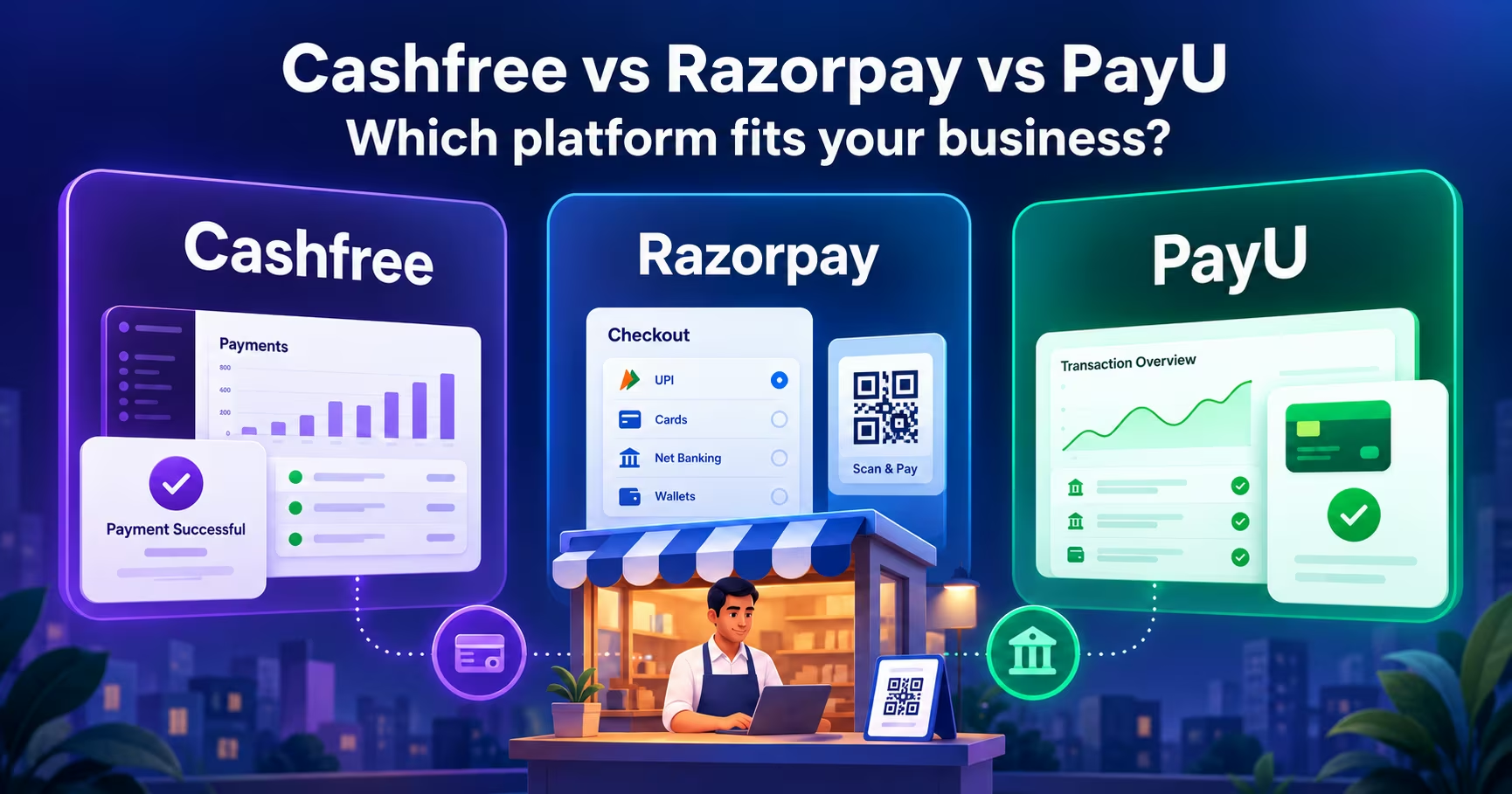
Cashfree, Razorpay and PayU all cover the basic requirements of online payment acceptance in India. The better choice for an SME comes down to five practical questions:
- What will it cost at the current volume?
- How soon can you start accepting payments?
- When will the money reach your bank account?
- Can the gateway work with your website or app?
- What support will you receive when something goes wrong?
SMEs don't have the luxury to work with dedicated IT departments nor do they have deep cash reserves to build their own infrastructure. Your business basically needs the right infrastructure with plug-and-play options, scales as your business grows, and does not drain the early stage revenue by charging additional fees.
Cashfree right now aligns with all these requirements and an SME's early stage realities. With 0% MDR on qualifying payment gateway sales up to ₹20 lakh, next-day settlement, the ability to go live in minutes and a dedicated account manager for eligible GST-registered businesses Cashfree removes the immediate technical and financial friction that generally troubles a small team
Razorpay and PayU remain alternatives, but their merchant-specific pricing, settlement and support terms need to be considered separately.
The SME Shortlist
| SME requirement | Cashfree | Razorpay | PayU |
|---|
| Initial processing cost | 0% MDR on eligible qualifying sales up to ₹20 lakh under the current offer | Standard domestic pricing generally starts at 2% plus GST | 2% for many domestic payment methods, plus GST |
| Standard settlement position | Next-day settlement included in the current eligible offer | Approved cycle depends on merchant account and settlement option | Approved cycle depends on merchant profile and agreement |
| Activation | Paperless onboarding; eligible, documentation-ready businesses can go live in minutes | Online onboarding subject to KYC and business verification | Online onboarding subject to KYC and business verification |
| Payment coverage | 180+ payment modes | 100+ payment modes | 150+ payment modes |
| Ecommerce and technical setup | Plugins, hosted checkout, SDKs, APIs and no-code options | Plugins, checkout tools, SDKs and APIs | Web checkout, plugins and developer integrations |
| Account support | Dedicated account manager for eligible GST-registered businesses | Account-management access depends on profile and arrangement | Account-management access depends on profile and arrangement |
| Overall SME fit | Strongest combination of cost, settlement speed, setup and guided support | Standard alternative for online payment acceptance | Standard alternative with broad payment-method coverage |
Published rates and offers are not the final price for every business. Payment method, transaction type, risk category, taxes, negotiated terms and promotional eligibility can change the actual cost.
Question 1: Which Gateway Is More Affordable for an SME?
An SME should compare payment costs in rupees, not just percentages. A 2% fee appears small on one transaction, but it becomes meaningful when applied to a full month of sales.
For an SME, the standard 2% payment gateway fee is not just a line item, but it amounts to capital diverted from operations. Businesses processing ₹15 lakh revenue in a month will pay around ₹30,000 in fees to the payment gateway.
This amount can fund a critical software subscription, inventory, or even a part-time hire.
Cashfree
Cashfree publishes its current offer, new merchants can process domestic payment gateway transactions at 0% MDR up to a cumulative ₹20 lakh.
Cashfree automatically applies the offer after successful KYC approval and account activation for eligible merchants. Certain payment methods and categories are excluded, and GST continues to apply according to the published conditions. SMEs should review Cashfree's official pricing and offer terms before signup.
Razorpay
Razorpay's standard domestic payment gateway pricing generally starts at 2% plus GST per successful transaction across common payment methods. Other rates can apply to international cards, EMI and selected payment categories. The final cost should be checked against the merchant's approved schedule.
PayU
PayU publishes 2% pricing for Visa, Mastercard, net banking, BNPL and wallets on domestic transactions. It lists 3% for categories such as Diners, American Express, EMI and international transactions, with GST applicable. There is no standard setup fee under its published pricing.
SME decision
Cashfree has the clearest cost advantage for a new SME that qualifies for the current 0% MDR offer and this acts as a growth subsidy allowing SMEs to preserve their margins that too during the most vulnerable scaling phase. Razorpay and PayU are closer to each other at the headline domestic rate, although method-wise and negotiated charges can change the final comparison.
Question 2: Which Gateway Helps an SME Manage Cash Flow Better?
Transaction pricing affects margin, while settlement timing affects working capital. An SME may need revenue from today's sales to buy inventory, pay suppliers, fund deliveries or continue advertising.
Cashfree includes next-day settlement in its current eligible offer. The published terms describe a T+1 default cycle during the campaign, subject to banking schedules, account approval and applicable conditions. This makes the offer more useful than a processing discount on its own: eligible merchants can reduce initial gateway cost without accepting an extended wait for their sales revenue.
Razorpay's standard settlement timing is T+2. Faster settlement options may be available to eligible businesses and can carry separate charges or conditions.
PayU's standard settlement cycle is also T+2. Priority settlement is available to eligible merchants, but the timing and commercial conditions should be confirmed before activation.
SME decision
Cashfree is the more straightforward option when an SME wants a clearly stated next-day settlement benefit. When evaluating Razorpay or PayU, ask for the default cycle in writing and confirm whether any faster schedule costs extra.
Question 3: Which Platform Is Easier to Start With?
For a small business, a delayed payment integration can delay the entire website or app launch. The actual onboarding timeline depends on KYC documents, website policies, business category, risk review and technical readiness, not only the time required to complete a signup form.
Cashfree offers paperless onboarding and says eligible businesses can go live in minutes when their documentation and integration requirements are ready. SMEs can use ecommerce plugins, hosted checkout, mobile SDKs, server-side APIs or no-code payment links and forms. This gives a business room to choose an implementation that matches its technical resources.
Razorpay uses an online onboarding process and supports plugins, APIs and SDKs. Activation remains subject to KYC, business verification and approval of the required payment methods.
PayU also provides online onboarding, web checkout and developer integrations. The activation timeline depends on documentation, business category and the products being enabled.
SME decision
All three can support a standard online integration. Cashfree is the better fit for an SME that wants the onboarding promise, ready-made integration and current pricing benefit to work as one package. "Go live in minutes" should still be understood as the fastest eligible path provided all the documentation and checks complete without any friction, not a guarantee for every applicant.
Question 4: Will the Gateway Support How Customers Want to Pay?
Most Indian SMEs need UPI, domestic credit and debit cards, net banking and wallets. Depending on average order value and business model, EMI, BNPL, subscriptions or international cards may also matter.
- Cashfree supports more than 180 payment modes across major domestic categories
- Razorpay advertises more than 100 modes
- PayU advertises more than 150 modes
Each provider offers the core options used by Indian customers, and individual methods remain subject to account approval.
However, the highest number of payment methods available does not make any one payment gateway a clear winner. An SME should identify its five or six most important customer payment methods and ask:
- Is each method included in the standard commercial rate?
- Does it require separate activation?
- How does its payment-success performance compare for the business's customer mix?
- Does it follow the same settlement cycle?
- Are refunds and reconciliation handled consistently across methods?
SME decision
There is no major basic-coverage gap among the three providers. Cashfree offers the broadest published count in this comparison, but the more meaningful advantage is that its payment coverage comes with multiple integration routes and its current SME-friendly commercial proposition.
Question 5: What Happens When the SME Needs Help?
Support becomes important when a checkout fails during a sales campaign, a payment method is not activated or a settlement does not reconcile as expected.
Smaller teams rarely have a dedicated payments specialist in-house to troubleshoot failed checkouts and delayed payments. Where generic ticketing can cost SMEs days of lost revenue, Cashfree addresses this gap with its dedicated account manager offering.
Only available to GST-registered businesses, accessing a direct line to a dedicated account manager right after onboarding ensures any escalation is resolved quickly.
Razorpay and PayU provide merchant support, while named account-management access depends on the business profile, volume and commercial arrangement. SMEs should ask each provider about service hours, escalation channels and response commitments rather than assuming that every account includes the same support level.
SME decision
Cashfree is better positioned for an eligible SME that values guided account support. The advantage is strongest when the approved agreement clearly states who the contact is and what assistance is included.
Choose Based on Your SME Profile
You are taking your first business online
Cashfree is a no-brainer choice for an eligible business taking its first steps online if it qualifies for 0% MDR and wants a quick, paperless route to payment acceptance. Moreover, a ready-to-install plugin or hosted checkout can reduce the technical workload for SMEs, enabling them to focus on the business rather than spending time building payment infrastructure.
You sell physical products and replenish stock frequently
Cashfree's next-day settlement is particularly relevant because access to sales revenue can influence how quickly the business restocks and fulfils new orders.
You operate with narrow margins
Start with the total cost at your expected monthly volume. Cashfree's eligible 0% MDR benefit can materially reduce initial processing expense. After the offer, compare the approved blended rate across the payment methods customers actually use.
You already use a developer-led website or mobile app
All three support APIs and SDKs. Compare documentation against the exact technology stack, then include settlement and support terms in the decision rather than choosing on integration capability alone.
You expect transaction volume to increase quickly
Ask for the rate, settlement cycle and support entitlement that will apply after the introductory stage. Cashfree's current offer provides a strong starting position, but the longer-term agreement should also fit the projected volume.
The SME Cost and Operations Checklist
Before choosing a platform, request written answers to the following:
- What rate applies to UPI, cards, net banking, wallets, EMI and international payments?
- Which transactions qualify for any promotional pricing?
- What rate starts after the offer or qualifying limit ends?
- What is the default settlement cycle for this merchant account?
- Do weekends and bank holidays change settlement timing?
- Are setup, maintenance, refund or dispute-related charges applicable?
- Which plugins, APIs or SDKs support the current website or app?
- Is a dedicated account manager included?
- What is the escalation route for a live checkout problem?
- Can reports be reconciled easily with order and accounting records?
This checklist turns a broad brand comparison into a merchant-specific decision. It also makes it easier to identify whether an attractive headline rate is supported by suitable settlement, integration and service terms.
Final Recommendation for SMEs
For any SME, a payment gateway must function as a growth enabler and not a cost center.
Its advantage is the combined value of 0% MDR on qualifying payment gateway sales up to ₹20 lakh, next-day settlement, quick go-live capability and a dedicated account manager for eligible GST-registered businesses.
Razorpay and PayU both provide the core payment methods and integration routes an SME would expect. They remain alternatives to comparison using merchant-specific proposals, but Cashfree's combination of introductory cost, settlement speed, onboarding and account support gives it a particularly strong proposition for eligible new SMEs.
For an SME that wants to start accepting payments quickly, preserve early margins and maintain predictable access to sales revenue, Cashfree is a no-brainer choice under the current offer.
The final decision should still be based on approved written terms, payment mix, expected GMV, settlement requirements and post-promotional pricing.
Frequently Asked Questions
Which payment gateway is best for a small business in India?
Cashfree is a no-brainer choice for an eligible small business that prioritises introductory payment costs, next-day settlement, quick onboarding and dedicated account support. Its current offer combines 0% MDR on qualifying sales up to ₹20 lakh with the other operational benefits outlined above.
Is Cashfree cheaper than Razorpay and PayU?
Cashfree can be cheaper for eligible new merchants under its limited-period 0% MDR offer on qualifying domestic payment gateway transactions up to ₹20 lakh. Razorpay generally starts at 2% plus GST, while PayU publishes 2% for many domestic payment methods. Actual costs depend on the approved agreement and payment mix.
Does Cashfree provide next-day settlement to SMEs?
Cashfree's current eligible offer includes a T+1 or next-day settlement cycle, subject to campaign terms, banking schedules, risk checks and account approval.
Can an SME activate Cashfree without a developer?
Many SMEs can use hosted checkout, ecommerce plugins or no-code payment options without building a fully custom integration. Eligibility and activation still depend on completing KYC and meeting business and website requirements.
Does every SME receive a dedicated account manager?
Cashfree's current offer terms state that eligible GST-registered businesses receive a dedicated account manager. Businesses should confirm eligibility and the included service scope during onboarding.
Should an SME choose only by MDR?
No. MDR affects transaction cost, but settlement speed, payment success, integration effort, reconciliation, refunds and support can have an equal or greater impact on everyday operations.