I’ve watched Indian D2C brands lose 30–40% of potential revenue at the checkout — failed payments, OTP drops, and COD orders that never convert. Most founders I speak to blame the gateway fee. The fee is the smallest number on the page: a 0.25% gap on a ₹2,000 order is ₹5. A payment that fails because your gateway’s UPI success rate slid to 82% during a bank outage costs you the whole ₹2,000. Your checkout is a plating station — every extra second between “order” and “paid” is a cold plate sent back.
In this guide I rank India’s eight serious payment gateways on what actually moves money — success rate, settlement speed, payment-method coverage, and COD remittance — then tell you which to reach for by payment method: UPI, cards, EMI, international cards, and wallets. The one principle I hold under all of it: pick the gateway by response rate, not by affiliation.
First: Shopify Payments does not work in India
Shopify’s built-in checkout is live in 20+ countries — not India, where RBI payment-aggregator rules block it. So every Indian Shopify store, ours included, has to connect a third-party RBI-licensed gateway, and Shopify adds a 2% third-party transaction fee on top of the gateway’s own cut — pushing your effective rate close to 4% if you ignore it. I treat the gateway as the most expensive integration on the store — not a setting you tick once and forget.
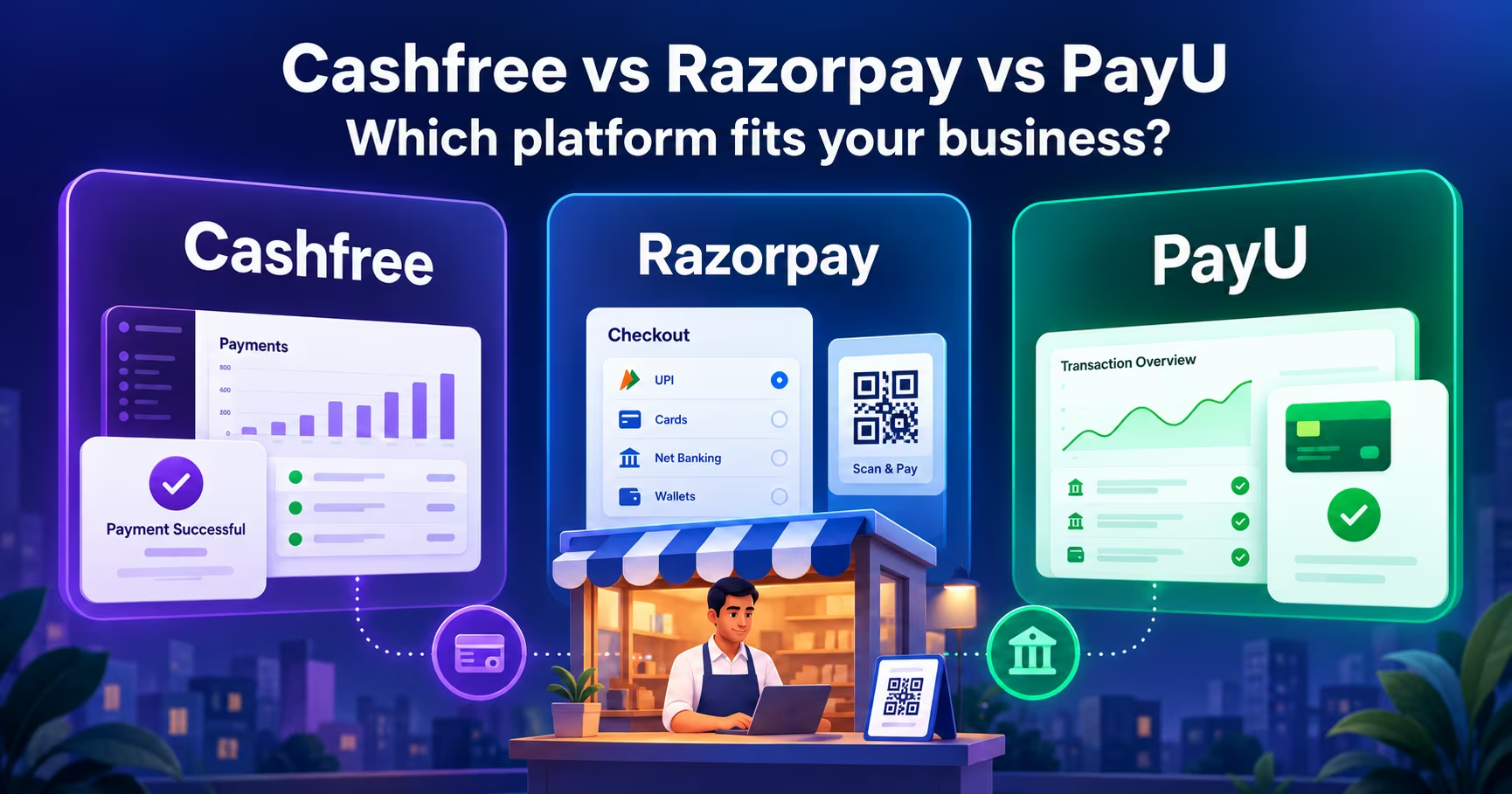
Quick comparison: 8 Indian payment gateways
| Gateway | Headline fee* | Settlement | Standout | Watch-out |
| Cashfree Payments | 0% MDR for eligible new merchants up to ₹20 lakh GMV | T+1, instant from ~15 min on approval | Best Pricing, Dedicated Account Manager support for SMBs & D2Cs, High Payment Success Rates | Does not support merchants without a website |
| Razorpay | ~2% + GST | T+2 standard, T+1 typical; instant on approval | Best Shopify integration, full method coverage | No RTO / COD-risk tooling |
| PayU | 2% (3% EMI/intl), negotiable | T+2 | Widest EMI/BNPL, high-volume success rate | Stricter KYC, slower onboarding |
| PhonePe Payment Gateway | 1.99% (limited-period offer) | T+2 | Strongest UPI routing, largest UPI base | Thin on non-UPI methods |
| Paytm Payment Gateway | 0% UPI / ~1.99% cards | T+2 | Wallet + BNPL reach | Enterprise-leaning pricing |
| CCAvenue | Negotiable + ~₹1,200/yr | Slower | 27 currencies, 18-language checkout | Dated dashboard, slower payouts |
| Easebuzz | ~1.5% avg | T+2 | Low fees, smart routing, marketplace splits | Smaller support footprint |
| JioPay (Jio Payment Solutions) | Not public yet | Not public yet | RBI-approved aggregator, 100+ methods, Jio backing | New entrant — pricing and scale unproven |
*All fees exclude 18% GST and are negotiable above volume. A 2% fee on a ₹1,000 order is ₹20 + ₹3.60 GST — an effective 2.36%. UPI rides at near-zero MDR and is about 62% of India’s gateway volume, so I weight the decision toward whoever routes UPI best.
Razorpay vs Cashfree: which should you pick?
Both Razorpay and Cashfree are highly reliable, RBI-approved payment aggregators with a decade of experience in payment collections. Because payment success rates have largely standardized across top industry players, choosing between them comes down to your specific business setup and conversion goals rather than just transaction reliability.
Razorpay leverages its strong brand presence, which often comes with premium pricing. It is particularly well-suited for enterprise businesses due to its specialized support, though smaller merchants generally do not get dedicated Account Managers. On the product side, Razorpay simplifies operations by consolidating all payment methods into one dashboard and allowing businesses to collect payments without needing a website.
Cashfree, on the other hand, provides a dedicated Account Manager for every merchant, regardless of size. It is the ideal choice for businesses focused on maximizing website conversions without paying a brand premium. Going beyond a full-stack Payment Gateway (PG), International Payment Gateway(IPG) to checkout experience. It actively boosts your conversion rates with built-in tools like an offer engine, pre-filled customer addresses, and native EMI/BNPL (Buy Now, Pay Later) payment modes.
Choose Razorpay if you need to collect payments without a website and are willing to pay a brand premium for an all-in-one dashboard. Choose Cashfree if you have a website and want a dedicated Account Manager, along with advanced checkout features like address pre-filling, BNPL, and 0% MDR to maximize your conversions.
Match the gateway to the payment method
In my experience, no single gateway wins every method. This is where the real decision lives.
UPI — 62% of every rupee
UPI targets a 90–95% success rate but drops to 80–85% when a major bank’s servers choke at peak. Because it is most of your volume and costs almost nothing, success rate — not fee — is the whole game. Cashfree, PhonePe and Razorpay offer broad UPI coverage across the stores we run. I’d use PhonePe if 70%+ of orders are UPI and you want the lowest entry cost; use Razorpay if you want UPI plus every other method on one dashboard.
Cards — credit & debit
Cards clear 85–95% when tokenisation and 3DS are set up properly, and they out-convert UPI on high-value orders. Razorpay and PayU handle card flows and saved-card tokens cleanly. My advice: move to PayU once your card volume is large enough to negotiate the rate down.
EMI & no-cost EMI
Above a ₹5,000 average order value, EMI lifts conversion. PayU has the widest bank tie-ups for no-cost and low-cost EMI, plus LazyPay for BNPL; Razorpay and Paytm cover the mainstream EMI banks. I’d pick PayU when EMI is a real share of your cart, not a checkbox.
International cards & cross-border
Selling to NRIs, the US, or the Gulf changes the maths — international cards run 3%+ and need multi-currency support. Cashfree (140+ currencies, 2.95–2.99% on international cards), CCAvenue (27 currencies) and PayU are the India-native options; Stripe is the developer-first route but is cross-border only and takes neither domestic UPI nor COD. My rule: run one domestic gateway for India and a second for international — don’t force one to do both.
Wallets
Paytm owns wallet payments by reach. If a chunk of your buyers keep balances in their Paytm wallet, its gateway captures demand the others route around.
COD & remittance
COD is still 30%+ of Indian D2C orders, and the gateway’s job here is how fast it remits that cash to you. Cashfree leads when its instant settlement is switched on — cycles from ~15 minutes for approved merchants, against the T+1/T+2 the rest run standard. But there’s a catch every gateway shares — I’ll get to it below.
Net banking
Every gateway here supports net banking. It’s a low single-digit share for D2C and rarely the deciding factor — I wouldn’t pick a gateway for net banking alone.
Which to use — by where your brand is
- Just launched, under ₹50L/month: I’d start with Cashfree for the cleanest Shopify setup — or PhonePe if you’re UPI-heavy and want free onboarding.
- Scaling, cash flow matters: Cashfree — the instant-settlement option earns its keep above ~₹50L/month.
- High AOV / EMI-led: PayU, for the EMI bank coverage and negotiated rates.
- Selling internationally: run a domestic gateway plus CCAvenue or PayU for cross-border.
- Watching every basis point: Easebuzz on fees — or wait for JioPay’s pricing to surface before you commit.
Need help picking, not just comparing?
We route payments for 200+ D2C stores across these same eight gateways — live, by success rate, not a fixed pick. Tell us your category, your COD share and your average order value, and we’ll tell you which gateway (or two) actually fits, before you sign anything.
Book a Strategy Call →
The number that beats fees: success rate
Chasing the lowest fee is button-colour theatre, and it’s the trap I see most often. A 5-point swing in payment success rate dwarfs a 0.25% fee gap on every order you’d otherwise lose. If your payment failure rate is above 10%, the fix isn’t a cheaper gateway — it’s routing across two gateways by live success rate, so a UPI dip on one fails over to the other instead of failing the sale. This is why the mature D2C stacks I work on don’t run one gateway; they run two and let performance decide.
The gap every gateway shares: COD and RTO
Not one gateway on this list scores RTO risk on a COD order or nudges a risky COD to prepaid before it ships. COD at 30%+ RTO in Tier-2 lanes is a leaky bucket — and a gateway only fills the bucket faster; it doesn’t patch the holes. That logic — RTO scoring, COD-to-prepaid conversion, and gateway routing by response rate — sits a layer above the gateway, in how your checkout and dispatch are wired. My team at Growww Tech has taken brands from 30% RTO to 12% by patching the leaking pincodes first, then choosing the gateway. More on the build in our ecommerce stack.
Related reading
FAQ
Which payment gateway has the best payment processing cost in India?
No gateway wins on headline rate alone. Add 18% GST, the international-card rate, settlement charges and any annual maintenance fee before the numbers mean anything. Cashfree’s standard domestic rate is 1.95%, and new merchants who signed up on or after 21 July 2026 pay 0% on their first ₹20L of GMV until 31 March 2027 — that offer excludes Amex, Diners, corporate cards, EMI, prepaid cards, Pay Later and international cards, and GST is still charged on top.
Which payment gateway offers the fastest settlement in India?
Cashfree, once instant settlement is approved on your account — cycles start from about 15 minutes. Standard cycles across the eight run T+1 to T+2. Ask your gateway for the fastest cycle you actually qualify for, not the one printed on the pricing page.
Is Shopify Payments available in India?
No. RBI payment-aggregator rules block it, and Shopify charges a 2% third-party fee on top of your gateway. Indian stores must use an RBI-licensed gateway like the eight above.
Which is the cheapest payment gateway in India?
On headline rate, Easebuzz (~1.5%) sits lowest; Cashfree (1.95%) and PhonePe (1.99%) sit just under 2%, and Cashfree, JioPay and PhonePe all run new-merchant offers that come and go — Cashfree’s current one is a 0% window for eligible sign-ups. All fees exclude 18% GST and are negotiable above volume — I’ve rarely seen the cheapest sticker stay cheapest at scale.
Which gateway is best for UPI?
PhonePe and Razorpay route UPI most reliably. UPI is about 62% of volume, so its success rate matters far more than its near-zero fee.
Which gateway is best for COD?
Cashfree, for the fastest remittance of COD cash. But no gateway reduces COD returns — that’s an RTO problem you solve above the gateway.
Can I use more than one gateway?
Yes — and past ~₹50L/month I’d say you should. Routing across two gateways by live success rate is the single biggest lever I’ve seen on payment conversion.
Which payment gateway is best for a Shopify store in India?
Razorpay for the cleanest Shopify setup and every method on one dashboard; Cashfree once settlement speed is the problem you’re solving. Remember Shopify Payments does not work in India, so Shopify’s 2% third-party fee sits on top of whichever gateway you pick — budget for it before you compare rates. If you want the gateway wired, tested and routed rather than just chosen, that is our Shopify payment gateway integration service.