The Indian D2C Opportunity in 2026
India’s D2C market is projected to cross $60 billion by 2027. I’ve watched brands like Mamaearth, boAt, and Licious prove you don’t need a distributor network or retail shelf space to build a ₹100 crore business.
Here’s what the Instagram gurus won’t tell you: 90% of D2C brands that launch in India fail within 18 months. Not because their products are bad — because they skip the fundamentals.
I’ll walk you through everything you need to get right, in the right order.
Phase 1: Validate Before You Build (Week 1-4)
Step 1: Find Your Niche (Don’t Sell “Everything”)
The biggest mistake I see: launching a store that sells “fashion” or “beauty products.” You’re up against Myntra and Nykaa — you’ll lose.
Go niche instead:
- Bad: “Women’s clothing” → competing with 50,000 stores
- Good: “Handloom cotton sarees from Andhra Pradesh” → specific, defensible, story-driven
- Bad: “Skincare products” → competing with Mamaearth, mCaffeine
- Good: “Ayurvedic hair oils for curly hair” → specific problem, specific audience
Validation test: Search your idea on Instagram. If 50+ accounts are already selling the same thing with poor branding, that’s a good sign — demand exists, and you can win on execution.
Step 2: Validate Demand Before Investing
Don’t manufacture 5,000 units of inventory before your first sale. Validate first:
- Create an Instagram page with 20-30 product mockups or samples
- Run ₹2,000 worth of Meta ads to a WhatsApp number
- If you get 50+ inquiries in a week, there’s demand
- Take pre-orders to fund your first production run
Total to validate: ₹5,000 – ₹10,000. That’s it.
Step 3: Calculate Your Unit Economics
Before you price anything, know your numbers:
| Cost Component | Example (₹999 MRP product) |
| Product cost (COGS) | ₹250 (25%) |
| Packaging | ₹30 (3%) |
| Shipping | ₹80 (8%) |
| Payment gateway fee (2%) | ₹20 (2%) |
| RTO cost (allocated) | ₹50 (5%) |
| Customer acquisition (Meta ads) | ₹200-400 (20-40%) |
| Total cost | ₹630-830 |
| Profit per order | ₹169-369 (17-37%) |
If your margin is below 20% after all costs, you’ll struggle to scale. Fix your pricing or COGS before you launch.
Need a hand with this? My team’s unit economics service builds these models for you.
Phase 2: Legal & Compliance (Week 2-4)
Step 4: Register Your Business
Start with one of these:
- Sole Proprietorship — cheapest, simplest, fine for testing. Register GST in your name.
- LLP (Limited Liability Partnership) — better for 2+ founders. ₹5,000-8,000 to register.
- Private Limited Company — if you plan to raise funding. ₹10,000-15,000 to register.
For most D2C starters, LLP is the sweet spot — limited liability, simple compliance, and you can convert to Pvt Ltd later when you raise funding.
Step 5: Get Your Compliance in Order
Non-negotiable registrations for Indian D2C:
- GST Registration — required if turnover exceeds ₹40 lakh (₹20 lakh for services). Get it anyway — you need it for shipping partners.
- FSSAI License — mandatory for food, supplements, skincare, cosmetics. ₹100 for basic registration.
- Trademark — file a TM application for your brand name immediately (₹4,500 government fee). Don’t wait — someone will squat on your name.
- MSME/Udyam Registration — free, gives you access to government schemes and priority lending.
My team’s compliance service handles all of this so you can stay on product and sales.
Step 6: Open a Business Bank Account
You’ll need this for payment gateway integration. Good options for D2C startups:
- Razorpay X — current account + payment gateway in one
- HDFC Current Account — traditional, works everywhere
- ICICI Startup Account — low balance requirements for registered startups
Phase 3: Build Your Store (Week 3-6)
Step 7: Choose Your Platform
For 80% of Indian D2C brands, Shopify Basic (₹1,994/month) is where I’d start. Read my detailed Shopify vs WooCommerce comparison if you’re unsure.
Step 8: Set Up Your Store
Essential pages every D2C store needs:
- Homepage — hero image, bestsellers, trust signals (reviews, press mentions)
- Product pages — high-quality photos, detailed descriptions, size charts, reviews
- About page — your founder story (Indian customers love knowing who’s behind the brand)
- Shipping & Returns policy — clear, honest, prominent
- Contact page — WhatsApp button, email, phone number
Want a store built fast? My Store & App team launches D2C stores in 2-4 weeks.
Step 9: Set Up Payments
Minimum payment options for India:
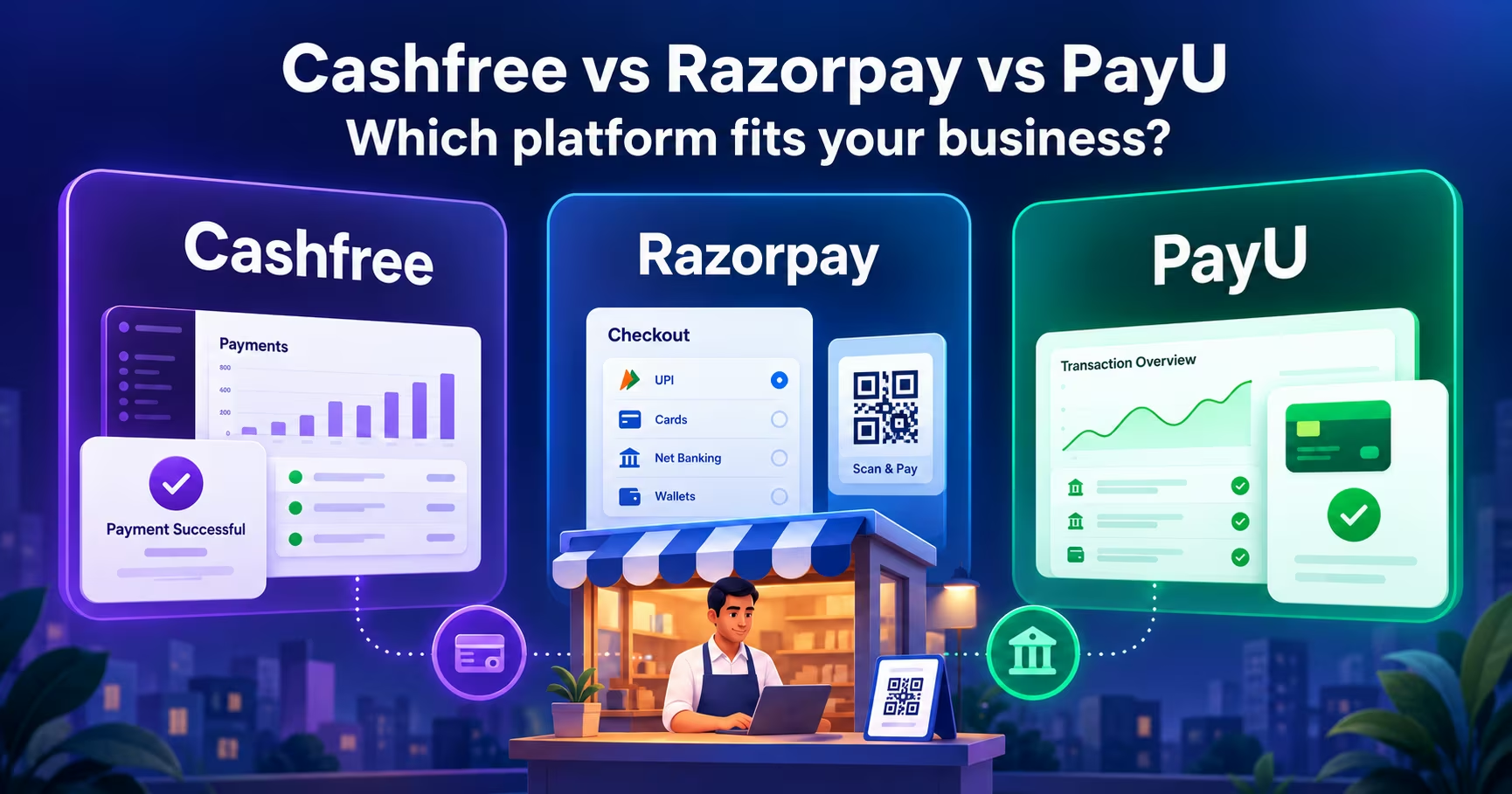
- UPI (Razorpay/Cashfree) — 50%+ of online payments in India are UPI
- Credit/Debit Cards — standard
- COD — you’ll lose sales without it, but manage RTO risk (see my RTO reduction guide)
- EMI — for products above ₹3,000, offer no-cost EMI via Razorpay
Step 10: Set Up Shipping
Register with a courier aggregator:
- Shiprocket — most popular, good rates, works with 17+ courier partners
- Delhivery — best for Tier 2-3 delivery
- Pickrr — good for smaller brands, competitive rates
Negotiate rates once you hit 100+ shipments/month. Starting rates: ₹50-80 per 500g shipment.
Phase 4: Your First 100 Orders (Week 5-12)
Step 11: Launch on Instagram First
Your first sales will come from Instagram, not Google. Here’s the playbook I give founders:
- Post 2-3 reels per week showing your product in use
- Share your founder story (why you started this brand)
- Use Instagram Shopping to tag products in posts
- Engage in comments of competitor pages (genuine comments, not spam)
- Collaborate with 5-10 micro-influencers (barter deals, no cash needed)
Step 12: Run Your First Meta Ad Campaign
Start with ₹500/day budget:
- Campaign type: Conversions (Purchase event)
- Audience: Broad targeting, let Meta’s algorithm find your buyers
- Creative: UGC-style video (phone-shot, authentic, under 30 seconds)
- Landing page: Send traffic directly to product page, not homepage
Expect your first sales within 3-5 days. CAC runs high at first (₹300-500) — it drops as the pixel learns.
The full details are in my performance marketing guide.
Step 13: Build a WhatsApp Community
Add every customer who buys from you to a WhatsApp broadcast list or community:
- Send new product launches exclusively to WhatsApp first
- Share behind-the-scenes content
- Ask for reviews and feedback
- Announce flash sales with 24-hour notice
WhatsApp marketing gets 90%+ open rates in India versus 20% for email. It’s your highest-ROI channel.
Phase 5: Scale to ₹10 Lakh/Month (Month 3-12)
Step 14: Expand to Marketplaces
Once your D2C store is profitable, expand to:
- Amazon India — massive reach, but high fees (25-40%)
- Flipkart — strong in Tier 2-3 cities
- Meesho — if you sell fashion at ₹300-800 price points
- Myntra — for fashion brands with premium positioning
Keep your D2C store as the primary channel — marketplaces are for incremental revenue, not brand building.
Step 15: Invest in Retention
Acquiring a new customer costs 5x more than keeping one you already have. Set up:
- Post-purchase WhatsApp flow — thank you → review request → referral incentive
- Loyalty program — points for purchases, referrals, reviews
- Email/WhatsApp automation — abandoned cart, win-back campaigns
- Subscription model — if applicable (consumables, skincare, food)
Target: 30%+ repeat purchase rate within 6 months. My retention team builds these systems.
Common Mistakes That Kill D2C Brands
- Spending on branding before validation — don’t pay ₹2 lakh for a logo before your first sale
- Ignoring unit economics — if you lose money on every order, more orders = more losses
- Over-investing in inventory — start with 200-500 units, not 5,000
- Copying competitor pricing — they might be burning VC money; you’re not
- Neglecting mobile experience — 85%+ of Indian ecommerce traffic is mobile
- No WhatsApp integration — you’re leaving the highest-ROI channel unused
The Investment: How Much Do You Actually Need?
| Category | Budget Launch | Standard Launch |
| Business registration + compliance | ₹5,000 – ₹15,000 | ₹15,000 – ₹30,000 |
| Shopify store setup | ₹2,000 – ₹5,000 | ₹25,000 – ₹75,000 (professional build) |
| Initial inventory | ₹25,000 – ₹1,00,000 | ₹1,00,000 – ₹5,00,000 |
| Product photography | ₹5,000 (phone + good lighting) | ₹15,000 – ₹30,000 (professional) |
| Meta ads (first 3 months) | ₹30,000 – ₹60,000 | ₹1,00,000 – ₹3,00,000 |
| Packaging | ₹5,000 – ₹15,000 | ₹15,000 – ₹40,000 |
| Total | ₹72,000 – ₹2,00,000 | ₹2,70,000 – ₹9,75,000 |
Yes, you can launch a real D2C brand for under ₹2 lakh. It won’t be glamorous, but it’ll turn profitable faster.
Ready to launch? Pick your budget on a 30-minute call
The hardest part of launching isn’t the registration paperwork or the Shopify setup — it’s knowing how much to spend at each stage and what to skip. I’ll diagnose where you are and scope the build in 30 minutes. No sales pitch. You walk away with a clear roadmap whether you hire us or not. 200+ Indian D2C brands launched. ₹385Cr+ revenue processed. 4.5x average ROI. 98% retention.
The Shopify build is ₹50,000 fixed-price with no AMC — bug fixes for what we ship stay included for the lifetime of the store. You ship on the Growww Tech custom theme customised to your brand, with payment gateway, Shiprocket, GST, and WhatsApp wired in by day one.